
Taj Mahal Quartzite vs Taj Mahal Engineered Quartz: Key Differences
Two countertop materials share the Taj Mahal name, yet they are fundamentally different products. Taj Mahal Quartzite is natural stone quarried from the earth. Taj Mahal engineered quartz is a manufactured material. Origin shapes everything else: quartzite delivers one-of-a-kind slabs, while engineered quartz offers consistent color and pattern. Maintenance needs also diverge, and outdoor suitability separates the two sharply. This comparison of Taj Mahal Quartzite vs Taj Mahal Engineered Quartz examines performance, applications, compliance, and cost side by side. MRD Stone supplies both categories, so the goal here is simple: help readers match the right material to their project, whether that means a unique beige quartz slab or a repeatable engineered surface.
Key Takeaways
-
Taj Mahal Quartzite is natural stone with unique patterns. Taj Mahal Engineered Quartz is manufactured for consistent color.
-
Quartzite handles heat well and suits outdoor use. Engineered quartz resists stains and needs no sealing.
-
Quartzite requires periodic sealing to prevent stains. Engineered quartz offers easy care with soap and water.
-
Engineered quartz costs less than quartzite. Quartzite provides natural beauty and heat tolerance.
-
Choose quartzite for unique style and durability. Choose engineered quartz for low maintenance and uniformity.
Taj Mahal Quartzite vs Taj Mahal Engineered Quartz: The Basics
What Is Taj Mahal Quartzite?
Taj Mahal Quartzite is 100% natural stone. It forms from sandstone that recrystallizes under extreme heat and pressure deep in the Earth's crust, a process called metamorphism. Taj Mahal Quartzite originates from Ceará, Brazil, and this transformation unfolds over millions of years. The heat realigns the mineral grains, and the pressure compresses the sand grains into a dense, interconnected network. The result is a hard, durable surface with a creamy off-white base and soft, flowing veins. Many buyers describe the look as a warm beige quartz slab with subtle movement.
The mineral composition of quartzite generally looks like this:
| Component | Proportion |
|---|---|
| Quartz | 88–98% |
| Iron hydroxides | 2–3% |
| Silicon and chalcedony | 4–5% |
| Impurities (mica, talc, feldspar, and other minerals) | Present |
Perla Venata quartzite is Taj Mahal Quartzite's closest look-alike. It shares the creamy off-white base but shows slightly bolder, more fluid veining.
For buyers exploring natural stone options, MRD Stone offers a range of natural stone slabs for different interior and architectural applications.
What Is Taj Mahal Engineered Quartz?
Taj Mahal engineered quartz is a manufactured material. It contains roughly 90–93% quartz crystals bound with resins and pigments. Manufacturers design it to resemble its natural quartzite counterpart while offering low-maintenance benefits. The surface is non-porous, and the color and pattern stay consistent from slab to slab. This consistency helps when a project needs repeatable results across a large kitchen or a multi-unit build.

Both materials are legitimate options. The Taj Mahal Quartzite vs Taj Mahal Engineered Quartz comparison comes down to matching material to project. Natural quartzite rewards buyers who want one-of-a-kind depth and variation. Engineered quartz rewards buyers who want predictability and easy care. Neither choice is inherently better; each one fits a different set of priorities.
MRD Stone's Taj Mahal Full Body Engineered Quartz is one option for projects that require a consistent beige appearance and a manufactured quartz surface.
Performance: Hardness, Porosity, and Heat
Hardness and Heat Resistance
Hardness determines how well a surface resists scratches from daily use. Taj Mahal Quartzite scores 7 to 7.5 on the Mohs scale. Typical steel kitchen knives test at 5.5 Mohs, so cutlery will not normally scratch this natural stone. Taj Mahal Quartzite is generally rated at 7–8 Mohs, while Taj Mahal engineered quartz is around 7 Mohs, with resin affecting the overall hardness slightly. Both materials handle routine wear well. The table below summarizes the comparison.
| Material | Hardness |
|---|---|
| Taj Mahal Engineered Quartz | Around 7 Mohs, with resin affecting hardness slightly |
| Taj Mahal Quartzite | 7–8 Mohs |
Heat resistance separates the two materials more sharply. Taj Mahal Quartzite withstands temperatures exceeding 1,200°F. The stone contains zero plastic binders, so hot pots and pans are less likely to damage it. Serious cooks value this tolerance. Engineered quartz behaves differently. Most polyester resins in Taj Mahal engineered quartz begin to destabilize, yellow, or scorch at approximately 300°F (150°C). A hot pan placed directly on the surface can leave a permanent burn mark. The chart below compares the heat resistance ratings of both materials.
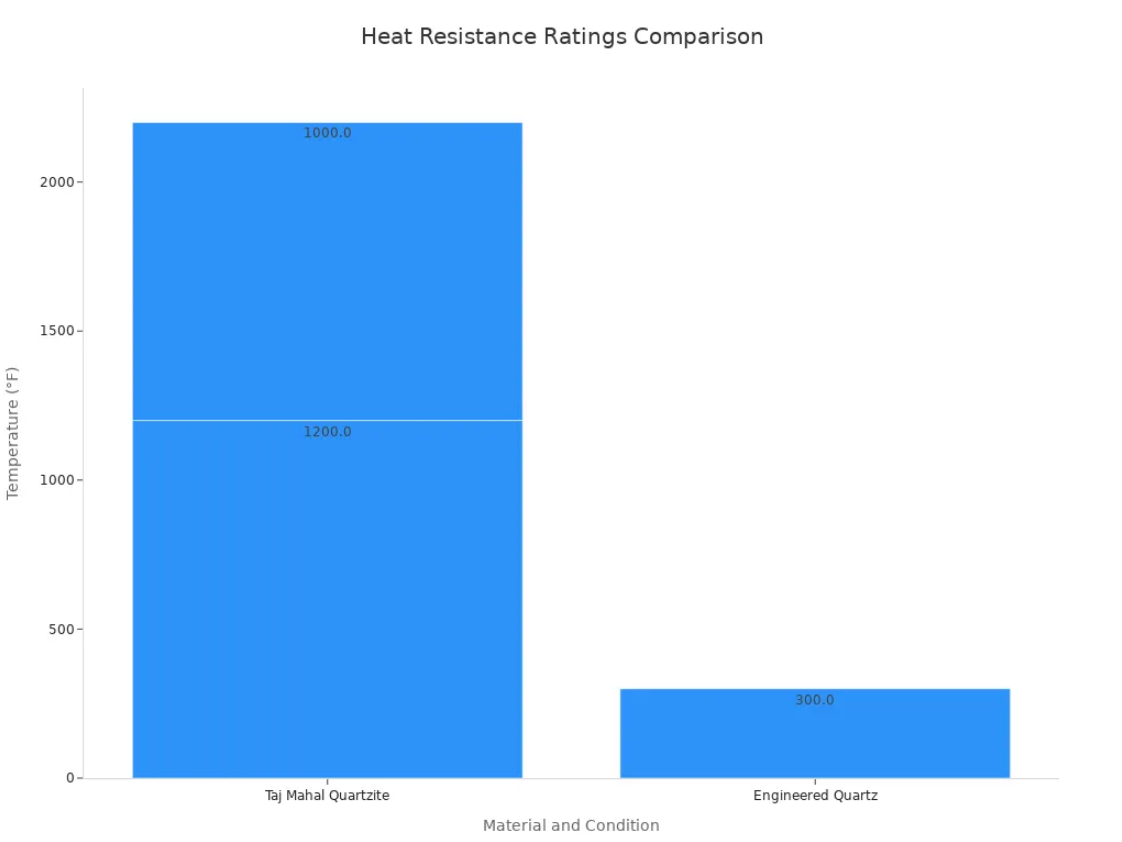
Natural quartzite does not contain a resin binder and generally tolerates heat better. Engineered quartz contains resin that can discolor under concentrated heat. A heat-resistant mat is still the safest practice on either countertop surface.
Porosity and Stain Resistance
Porosity governs how a surface reacts to spills. Taj Mahal Quartzite is a natural, porous stone. Its water absorption rate is reported at approximately 0.02%–0.05%, a low figure that still leaves room for liquid migration over time. Other measurements place porosity around 0.2% to 0.4% and water absorption below 0.4% by mass under ASTM C97. Despite impressive hardness, the stone can absorb liquids and oils if left unprotected. Sealing is therefore essential. Owners should seal Taj Mahal quartzite periodically with a high-quality impregnating sealer. General maintenance guidance recommends sealing once or twice a year, depending on the stone and its use. A neglected surface can stain from oil or acidic juice left overnight, though the stone is significantly more forgiving than marble.
Engineered quartz takes the opposite approach. Taj Mahal engineered quartz is non-porous straight out of the factory and never needs sealing. The resin binder makes the surface non-porous and resistant to everyday staining with very little upkeep. Hot pans should still rest on trivets, since resin can scorch. These are trade-offs, not flaws. The Taj Mahal Quartzite vs Taj Mahal Engineered Quartz decision on performance comes down to whether a buyer prefers natural heat tolerance with periodic sealing or a sealed-for-life surface with heat limits. MRD Stone supplies both categories, so buyers can weigh each option against their cooking habits and care routine.

Best Applications for Each Material
Kitchens and Bathrooms
Kitchen countertops remain one of the most popular uses for Taj Mahal quartzite. The stone resists heat, so cooks can place hot pots directly on the surface. It also holds up well to daily wear, which suits busy households. Waterfall islands and full-height backsplashes highlight the stone's veining and turn a kitchen into a statement design. A full-height Taj Mahal quartzite backsplash looks very high-end when the fabricator plans the slab movement correctly.
Bathrooms reward the same material in different ways. Taj Mahal quartzite can create a spa-like environment with fewer grout lines. Homeowners can extend the stone to vanity tops, shower walls, and the surround of the tub. Vanity tops, tub decks, wall features, and selected shower applications are strong fits when the design calls for a warm, spa-like feeling. The stone lends a peaceful, grounded tone that enhances serenity in bathroom design.
Taj Mahal engineered quartz fits a different household profile. Low-maintenance families value its non-porous surface and consistent pattern. The material suits large kitchens and multi-unit projects that need repeatable results. A beige engineered quartz slab from MRD Stone delivers that same warm look without sealing chores. Cooks who want natural depth and heat tolerance lean toward quartzite. Households that prioritize easy care lean toward engineered quartz.
Outdoor Use and High-Traffic Areas
Outdoor projects favor natural quartzite. Taj Mahal quartzite is generally considered sun and UV resistant, which makes it a practical choice for outdoor applications. The same natural stone offers exceptional structural strength. It can work in some outdoor areas, such as an open kitchen design, though those spaces require appropriate installation and care. Engineered quartz is generally intended for indoor applications, so it fits poorly in sun-exposed settings.
High-traffic areas call for a closer look at both options. The table below summarizes the relevant attributes of natural Taj Mahal quartzite.
| Attribute | Detail |
|---|---|
| Hardness (Mohs) | 7 to 7.5 |
| Scratch Resistance | Very Good |
| Stain Resistance | Good with sealing |
| Porosity | Slightly Porous |
| Maintenance | Periodic Sealing |
| Commercial Spaces | Suitable for hotels, offices, and showrooms |
| High-Traffic Flooring | Suitable for floors with high traffic when properly installed |
| Heavy Impact | Can chip or crack under heavy impact |
Engineered quartz counters offer a consistent, non-porous surface. Quartzite counters offer durability and natural variation. Taj Mahal quartzite is also used in commercial places, including hotels, offices, and showrooms, due to its long-lasting appearance and practicality. The Taj Mahal Quartzite vs Taj Mahal Engineered Quartz choice in these settings depends on whether the project values uniformity or natural character. MRD Stone supplies both categories, so specifiers can match each surface to its setting.
Safety Standards and Certifications
Compliance for Natural and Engineered Stone
Both Taj Mahal quartzite and Taj Mahal engineered quartz can meet applicable safety standards when buyers source them from reputable suppliers. The material category does not decide compliance on its own. A supplier's quality control system and its documentation decide it. Natural stone and engineered stone each require appropriate testing and documentation for food contact, emissions, and structural performance, depending on the intended application and market. Buyers should ask for current certificates instead of accepting a verbal assurance. Fabrication shops also follow OSHA silica rules, which set a permissible exposure limit of 50 micrograms of respirable crystalline silica per cubic meter of air over an eight-hour shift. That rule governs the workshop rather than the finished countertop. It still tells buyers something useful about a fabricator's professionalism and housekeeping.
Certifications Worth Checking
MRD Stone holds ISO9001, NSF, BV, and SGS certifications, which serve as practical examples of the credentials buyers can look for. Each one covers a different dimension of quality and compliance.
| Certification | What it signifies for stone products |
|---|---|
| ISO9001 | The company's management processes are effectively controlled and meet customer and legal requirements. |
| NSF (ANSI 51) | The applicable countertop material or component meets relevant food equipment material requirements for its intended use. |
| BV | Independent assessment covering relevant company, production, or quality management information. |
| SGS (EU CE) | Third-party testing or verification may support the assessment of applicable product requirements. CE compliance must be confirmed against the relevant product category and regulations. |
These credentials do not favor one material over the other. They simply show that a supplier has submitted to outside review and passed it. Buyers comparing quotes should request copies of the certificates and confirm that each one applies to the specific product line under consideration. A certificate for one slab range does not automatically cover every item a supplier sells. Buyers can also review MRD Stone's certification information when evaluating supplier qualifications.
Cost and Long-Term Value: Quartzite vs Engineered Quartz
Price Range and Installation
Taj Mahal Quartzite carries a higher price tag. Typical market estimates place slab costs at $90–$120 per square foot, reflecting the stone's rarity. Fabrication and installation add $45–$70 per square foot, so the total estimate lands at $135–$190 per square foot. Taj Mahal engineered quartz costs less at every stage. Slabs run $60–$80 per square foot, and fabrication and installation add $30–$50, for a total of $90–$130 per square foot. Prices vary by region, slab quality, and project complexity.
Fabrication difficulty explains much of the gap. Quartzite is much harder than granite, so it wears down diamond blades faster and demands more time and skill to cut and shape. Natural quartzite can also be more brittle in certain areas depending on veining and impurities, which requires extra care around sink cutouts and edges. Working with quartzite often requires heavier-duty tools, slower cutting speeds, and more experienced labor. Engineered quartz is more forgiving and accepts standard tools and techniques, which reduces time and labor expenses. MRD Stone supplies both categories, so buyers can compare complete installed quotes on equal terms.
Maintenance and Long-Term Value
Sealing drives the long-term cost picture for natural stone. General trade guidance suggests sealing Taj Mahal Quartzite annually to every two years, depending on sealer performance and kitchen intensity. Other maintenance recommendations put the interval at every 2–3 years under normal residential use. A simple water-drop test shows when resealing is needed: if the water beads, the sealer is working, and if the stone darkens, it is time to reseal. Proper sealing reduces stain ingress into tiny fissures. Annual inspection of seams, sink cutouts, and exposed edges catches micro-chips early, when conservative repair remains possible.
Engineered quartz removes that task entirely. Taj Mahal engineered quartz is non-porous and never needs sealing. It resists stains from coffee, wine, and oil, and everyday cleaning is simply soap and water. Natural quartzite can also offer long-term value through its durability and distinctive appearance, although owners should account for periodic sealing and potential repairs. The Taj Mahal Quartzite vs Taj Mahal Engineered Quartz cost question therefore depends on priorities. Buyers who want a beige quartz slab with natural depth accept periodic sealing. Buyers who want predictable upkeep choose engineered quartz.
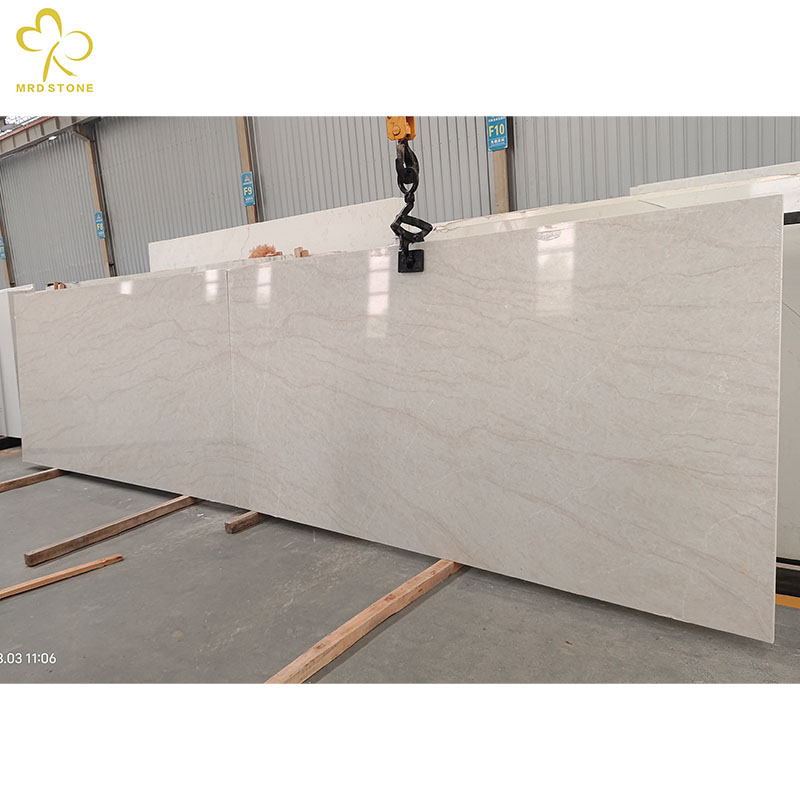
The Taj Mahal Quartzite vs Taj Mahal Engineered Quartz comparison comes down to origin, variation, and care. Buyers who prize natural uniqueness and heat resistance should choose Taj Mahal quartzite. Households that value consistency and low maintenance will prefer Taj Mahal engineered quartz. Outdoor and high-traffic projects favor natural quartzite for its UV and weather resistance. Neither material wins outright; each one fits a distinct project. MRD Stone supplies both categories, so buyers can compare samples side by side. Order a small sample of each, place them in the actual lighting, and request complete installed quotes before deciding.
For project-specific recommendations, slab specifications, or pricing, buyers can contact MRD Stone to discuss their countertop requirements.
FAQ
Does Taj Mahal quartzite need sealing?
Yes. Taj Mahal quartzite is a natural, porous stone. Trade guidance recommends sealing it annually to every two years, depending on sealer performance and kitchen use. A simple water-drop test shows when resealing is due. If the water beads, the sealer still works. If the stone darkens, it is time to reseal.
Can Taj Mahal engineered quartz go outside?
Generally, no. Manufacturers intend Taj Mahal engineered quartz for indoor applications. Its resin binder can degrade under prolonged sun exposure. Natural Taj Mahal quartzite resists UV and suits outdoor kitchens and patios far better. Buyers planning an outdoor surface should choose the natural stone.
Which material resists heat better?
Taj Mahal quartzite wins on heat. It withstands temperatures exceeding 1,200°F and contains no plastic binders. Resins in Taj Mahal engineered quartz begin to destabilize or scorch at approximately 300°F. Even so, a trivet remains good practice on either surface.
Is engineered quartz cheaper than quartzite?
Yes. Taj Mahal quartzite slabs run $90–$120 per square foot, and fabrication and installation add $45–$70. Taj Mahal engineered quartz slabs cost $60–$80 per square foot, with $30–$50 for fabrication and installation. Regional pricing and slab quality shift these figures.
Which option suits a low-maintenance kitchen?
Taj Mahal engineered quartz suits low-maintenance households. Its non-porous surface never needs sealing and resists coffee, wine, and oil stains. A beige quartz slab from MRD Stone delivers that warm look with soap-and-water care. Cooks who want natural depth and heat tolerance may still prefer quartzite.