
Seamless Pipes for Exhausts: Benefits & Wall Thickness Factors
What Wall Thickness Do Exhaust Pipes Need? A Complete Guide to Materials and Applications
Most passenger car exhaust pipes use wall thicknesses between 1.2mm and 2.0mm, depending on the pipe diameter, material, exhaust section, and driving conditions. For many street performance applications, 1.5mm 304 stainless steel is a practical starting point, while 2.0mm tubing may be preferred for heavier-duty applications or components exposed to greater mechanical loads. Exhaust manifolds, downpipes, mid-pipes, and tailpipes do not necessarily require the same wall thickness. The right specification should balance heat resistance, vibration durability, weight, corrosion resistance, and manufacturing requirements rather than relying on engine displacement alone.
Seamless and welded exhaust pipes also have different manufacturing characteristics. A seamless tube has no longitudinal weld seam, while a welded tube is formed from sheet or strip and joined along a seam. Both can be suitable for exhaust applications when material quality, weld integrity, dimensions, and manufacturing processes meet the required specifications.
This guide explains how to select exhaust pipe wall thickness, compare common stainless steel grades, and match pipe specifications to different engine sizes and vehicle applications. It also covers practical considerations for automotive brands, exhaust manufacturers, and aftermarket parts buyers.
Updated: November 6, 2026 | Technical editorial: Jagrow Tuning
What Is Exhaust Pipe Wall Thickness and Why Does It Matter?
Exhaust pipe wall thickness refers to the distance between the inner and outer surfaces of a tube. It is normally measured in millimeters or inches and directly affects the component's weight, rigidity, heat transfer, forming characteristics, and resistance to mechanical damage.
For automotive exhaust system, wall thickness is not simply a matter of choosing the thickest available material. A thicker pipe can offer greater resistance to dents and handling damage, but it also adds weight and may increase material and fabrication costs. A thinner pipe reduces weight but requires sufficient structural support and careful control of vibration and installation loads.
Several factors make wall thickness an important design parameter:
- Structural strength: The pipe must withstand vehicle vibration, engine movement, exhaust system weight, and road impacts.
- Thermal cycling: Repeated heating and cooling can cause expansion, contraction, and fatigue stress.
- Weight: Thinner tubing can reduce the overall mass of a performance exhaust system.
- Corrosion allowance: Material selection and operating environment influence how much wall thickness is appropriate over the expected service life.
- Manufacturing: Wall thickness affects bending, expanding, flaring, welding, and dimensional consistency.
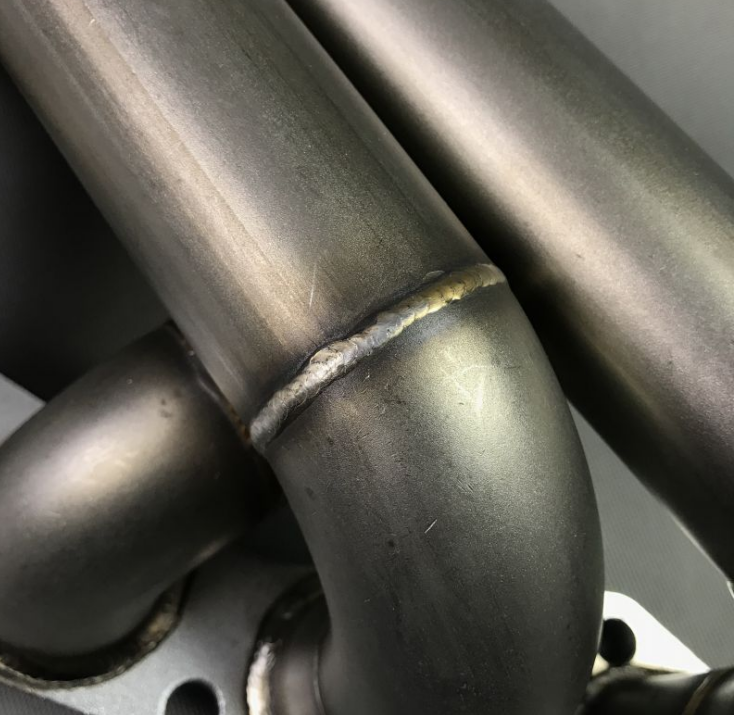
For custom exhaust manufacturing, pipe dimensions should be considered together with bend radius, flange design, hanger positions, and connection geometry. These details influence how the complete exhaust assembly fits and performs.
Jagrow develops customized exhaust components for different vehicle platforms. Explore Jagrow performance exhaust system for examples of stainless steel and titanium exhaust configurations.
How Does Engine Displacement Affect Exhaust Pipe Wall Thickness?
Engine displacement is a useful starting point when estimating exhaust system requirements, but it should never be the only factor used to determine wall thickness.
A larger engine may produce greater exhaust flow and thermal loads, particularly under high-load operation. However, the correct pipe thickness also depends on exhaust gas temperature, turbocharging, pipe diameter, component location, mounting support, and vehicle usage.
The following table provides preliminary selection ranges for common automotive exhaust projects. These are engineering starting points, not mandatory specifications or universal OEM standards.
| Engine Displacement | Typical Vehicle Application | Suggested Starting Wall Thickness | Main Consideration |
|---|---|---|---|
| 1.0–1.8L | Compact and economy cars | 1.2–1.5mm | Weight and everyday durability |
| 1.8–2.5L | Sedans and sport compact vehicles | 1.2–1.5mm | Balance of rigidity and weight |
| 2.5–3.5L | Performance cars and SUVs | 1.5–2.0mm | Thermal cycling and vibration |
| 3.5L+ | Large engines and high-performance builds | 1.5–2.0mm | Load, pipe diameter, and support |
| Turbocharged or racing applications | High-output and track vehicles | 1.5–2.0mm as an initial reference | Actual temperature, fatigue, and mounting loads |
For example, a 2.0L turbocharged engine used for track driving may place greater thermal and vibration demands on its exhaust components than a naturally aspirated 3.5L engine used mainly for highway driving.
Therefore, engineers should evaluate engine output, exhaust flow, material grade, pipe diameter, and operating conditions together before finalizing a specification.
What Wall Thickness Should Different Exhaust Sections Use?
Different parts of an exhaust system experience different temperatures, mechanical loads, and installation conditions. Using one wall thickness throughout the entire system is not always the most efficient solution.
Exhaust manifold and header primary tubes
Manifolds and headers are positioned close to the engine and experience frequent thermal cycling. For many stainless steel performance header projects, 1.2–1.5mm tubing is a reasonable starting range. Heavier construction may be considered where additional mechanical support or specific fabrication requirements justify it.
Header flanges are a separate design consideration. Jagrow's published exhaust specifications include flange thickness options of 10mm, 12mm, and 15mm. These flange dimensions should not be confused with the wall thickness of the exhaust tubing itself.

See Jagrow custom exhaust manifolds for examples of fabricated exhaust headers and manifold assemblies.
Turbocharger downpipes
Downpipes connect the turbocharger outlet to the remaining exhaust system. They can experience high thermal cycling, vibration, and movement caused by engine torque.
A preliminary wall thickness of 1.5–2.0mm is commonly considered for stainless steel performance downpipe projects. However, the actual specification should account for turbocharger outlet temperature, support brackets, flex joints, pipe diameter, and available installation space.
For turbocharged applications, proper mounting and flexible connections are particularly important because excessive movement can place additional stress on the pipe and weld joints.

Explore Jagrow exhaust downpipe products for different vehicle-specific and customized exhaust applications.
Mid-pipes and connecting pipes
Mid-pipes generally operate farther away from the engine than exhaust manifolds and turbocharger outlets. For many street performance applications, 1.2–1.5mm stainless steel tubing provides a practical balance of weight and structural requirements.
Additional thickness may be appropriate for large-diameter tubing, long unsupported sections, heavy exhaust assemblies, or applications exposed to road impacts.
Tailpipes and exhaust tips
Tailpipes are located near the rear of the vehicle and usually experience lower exhaust temperatures than the manifold area. Typical starting specifications are around 1.0–1.5mm, depending on the material, diameter, finish, and mechanical requirements.
Visible exhaust tips may require different material thicknesses or construction methods to achieve the desired appearance, rigidity, and surface finish.
| Exhaust Section | Suggested Starting Thickness | Primary Design Concern |
|---|---|---|
| Header primary tubes | 1.2–1.5mm | Thermal fatigue and vibration |
| Turbo downpipe | 1.5–2.0mm | High temperature and movement |
| Mid-pipe | 1.2–1.5mm | Weight and structural support |
| Tailpipe | 1.0–1.5mm | Appearance and corrosion resistance |
| Exhaust tips | 1.0–1.5mm as a starting reference | Finish and mechanical rigidity |
These ranges are preliminary design references for common automotive projects. They should be adjusted according to material specifications, component geometry, fabrication procedures, and vehicle-specific testing.
409 vs 304 vs 316L vs Inconel: Which Exhaust Pipe Material Is Better?
Material selection is just as important as wall thickness. Different stainless steel grades and nickel-based alloys provide different levels of corrosion resistance, oxidation resistance, mechanical strength, and manufacturing cost.
The four materials below cover common economical exhaust construction through more specialized high-temperature applications.
| Material | Main Characteristics | High-Temperature Behavior | Relative Material Cost | Typical Application |
|---|---|---|---|---|
| 409 Stainless Steel | Ferritic stainless steel, titanium stabilized | Designed for automotive exhaust oxidation conditions | Low | OEM exhaust pipes and economical system |
| 304 Stainless Steel | Austenitic stainless steel with good general corrosion resistance | Suitable for many performance exhaust applications | Medium | Performance manifolds, downpipes, and cat-back system |
| 316L Stainless Steel | Molybdenum-bearing austenitic stainless steel | Good corrosion resistance, especially in chloride-containing environments | High | Specialized corrosive environments and selected custom system |
| Inconel 625 | Nickel-chromium-molybdenum alloy | Manufacturer-published service temperature up to 1,800°F (982°C) | Very high | Specialized high-temperature and severe-duty applications |
409 stainless steel: Grade 409 is commonly associated with automotive exhaust system. Its ferritic structure and titanium stabilization make it suitable for exhaust applications where elevated-temperature oxidation resistance and cost efficiency are important. Surface discoloration or light surface rust may occur, so it is not usually selected for highly decorative exhaust finishes.
304 stainless steel: Grade 304 is widely used for aftermarket performance exhaust system. It offers a good balance of corrosion resistance, formability, weldability, and appearance. It is a practical choice for manufacturers producing custom headers, downpipes, and cat-back system.
316L stainless steel: Grade 316L contains molybdenum, which improves resistance to pitting and crevice corrosion in chloride-containing environments. However, it is not automatically a better choice for every exhaust component. Its higher material cost should be justified by the actual service environment and design requirements.
Inconel 625: This nickel-based alloy is designed for more demanding environments involving high temperatures, corrosion, and mechanical stress. Special Metals publishes a service temperature range up to 1,800°F (982°C). Its significantly higher material cost means it is generally reserved for specialized applications rather than ordinary street exhaust system.
For most aftermarket performance exhaust projects, 304 stainless steel remains a practical balance between cost, appearance, corrosion resistance, and fabrication requirements. Jagrow's published exhaust product range uses 304 stainless steel and titanium materials for customized exhaust assemblies.
Learn more about Jagrow stainless steel and titanium exhaust system for different performance vehicle applications.
Seamless vs Welded Exhaust Pipes: Which Should You Choose?
Seamless and welded pipes are two different manufacturing routes. The choice depends on the application, available dimensions, material grade, production volume, forming requirements, and quality control.
Seamless exhaust pipes are produced without a longitudinal weld seam. They can be useful in applications where seamless construction is specifically required by the design or specification. However, seamless construction does not automatically guarantee better fatigue resistance, longer service life, or lower pressure loss.
Welded exhaust pipes are manufactured by forming metal strip or sheet into a tube and joining the edges through a welding process. Properly manufactured welded tubing can provide reliable performance in automotive exhaust system. Weld quality, dimensional accuracy, material consistency, and inspection are important factors.
| Comparison | Seamless Pipe | Welded Pipe |
|---|---|---|
| Manufacturing | Formed without a longitudinal weld seam | Formed from strip or sheet and welded |
| Weld seam | No longitudinal seam | Contains a longitudinal manufacturing seam |
| Dimensional consistency | Depends on forming and finishing controls | Depends on welding and tube sizing controls |
| Production flexibility | Depends on available sizes and production methods | Often suitable for a broad range of custom tube sizes |
| Cost | Often higher for comparable material and dimensions | Often more economical for automotive tubing production |
| Key quality factor | Material integrity and dimensional tolerances | Weld integrity, sizing, and inspection |
It is important to distinguish between the longitudinal seam used to manufacture welded tubing and the joints used to fabricate a complete exhaust assembly. Even an exhaust system made from seamless tubes may still require welded bends, flanges, brackets, and connections.
For custom automotive exhaust system, a well-controlled TIG welding process can produce strong, consistent joints when the correct filler material, joint preparation, and welding procedure are used.
Jagrow's manufacturing capabilities include TIG welding lines for 304 stainless steel exhaust pipes, pipe bending equipment, and custom exhaust fixtures. These processes support the development of vehicle-specific exhaust assemblies rather than relying on a one-size-fits-all pipe design.

See Jagrow exhaust manufacturing and production capabilities for more information about fabrication and quality control.
How Does Pipe Diameter Affect Wall Thickness and Exhaust Performance?
Pipe diameter and wall thickness are closely related, but they serve different engineering purposes. Diameter influences exhaust flow area and packaging, while wall thickness affects structural rigidity, weight, and durability.
For a circular tube, the approximate internal diameter can be calculated as:
Internal Diameter = Outside Diameter − (2 × Wall Thickness)
For example, a pipe with a 63.5mm outside diameter and a 1.5mm wall thickness has an approximate internal diameter of 60.5mm.
Increasing wall thickness while keeping the outside diameter unchanged reduces the internal flow area. However, exhaust performance cannot be predicted from internal diameter alone. Gas velocity, engine operating range, exhaust pulse behavior, manifold design, bends, collectors, and downstream restrictions also affect the final result.
| Outside Diameter | Wall Thickness | Approx. Internal Diameter | Typical Consideration |
|---|---|---|---|
| 50.8mm | 1.2mm | 48.4mm | Lightweight exhaust tubing |
| 50.8mm | 1.5mm | 47.8mm | More wall material and rigidity |
| 63.5mm | 1.2mm | 61.1mm | Lightweight performance tubing |
| 63.5mm | 1.5mm | 60.5mm | Common performance exhaust reference |
| 76.2mm | 1.5mm | 73.2mm | Larger-diameter exhaust system |
| 76.2mm | 2.0mm | 72.2mm | Heavier-duty tubing reference |
These dimensions are geometric examples, not recommendations that one internal diameter will improve horsepower by a fixed percentage. Exhaust diameter should be selected according to engine airflow requirements and the complete system design.
For customized exhaust layouts, Jagrow can develop exhaust components based on customer samples, drawings, and vehicle-specific requirements. Explore Jagrow custom cat-back exhaust system for complete exhaust configurations.
What Other Factors Should You Consider When Selecting Exhaust Pipe Thickness?
Wall thickness selection should account for the entire vehicle and exhaust assembly, not only the engine displacement or material grade.
Vehicle usage: Daily-driven vehicles, track cars, off-road vehicles, and commercial vehicles have different vibration, impact, and thermal requirements. Off-road applications may need additional protection against mechanical damage.
Exhaust mounting and support: Long unsupported pipe sections can experience greater vibration and fatigue stress. Proper hanger positions, brackets, and flexible joints help reduce excessive movement.
Bending and fabrication: Thin-wall tubing may be more sensitive to wrinkling, flattening, or dimensional changes during tight-radius bends. The tube material, bending radius, tooling, and manufacturing process must be considered together.
Corrosion environment: Vehicles exposed to road salt, coastal air, water, and other corrosive conditions may benefit from more corrosion-resistant materials. Choosing a thicker wall alone does not replace proper material selection.
Budget and vehicle weight: Thicker tubing generally uses more material and adds weight. For performance builds, unnecessary thickness can increase total exhaust mass without providing a meaningful benefit.
Quality control: Material certificates, dimensional inspection, weld quality, and finished assembly checks all contribute to exhaust system reliability.
How Does Jagrow Manufacture Custom Exhaust system?
For automotive brands and aftermarket distributors, exhaust pipe selection is only one part of a successful product development project. Component fitment, material selection, bending accuracy, welding quality, and repeatable production all matter.
Jagrow has been engaged in automotive performance parts research, development, production, and sales since 2008. Its product range includes exhaust system, cooling components, and air intake system.
For exhaust manufacturing, Jagrow's published capabilities and product specifications include:
- 304 stainless steel and titanium exhaust material options.
- TIG welding lines for stainless steel exhaust components.
- More than 20 pipe bending machines supporting different bend radii.
- Custom exhaust development based on customer samples or drawings.
- Flange thickness options of 10mm, 12mm, and 15mm.
- Polished and brushed surface finish options.
- Vehicle-specific exhaust manifolds, downpipes, and cat-back system.
Jagrow also provides OEM and ODM development services for automotive performance brands. Customers can submit samples, technical drawings, or vehicle application details to discuss material, dimensions, fabrication, and customization requirements.
For distributors, tuning brands, and automotive parts wholesalers, this approach makes it easier to develop exhaust products that match specific vehicle platforms and market requirements.
Visit Jagrow Tuning to explore the complete automotive performance product range or discuss a customized exhaust project.
How to Choose the Right Exhaust Pipe Wall Thickness
The right exhaust pipe wall thickness is the result of balancing material, diameter, exhaust location, engine demands, and vehicle usage.
For many everyday and performance passenger vehicles, 1.2–1.5mm stainless steel tubing is a practical starting point for lighter exhaust sections. Downpipes, large-diameter tubing, and more demanding applications may require 1.5–2.0mm or a different specification based on mechanical and thermal requirements.
For material selection:
- Choose 409 stainless steel when cost efficiency and automotive exhaust oxidation resistance are priorities.
- Choose 304 stainless steel for a balanced combination of corrosion resistance, weldability, appearance, and performance applications.
- Consider 316L when chloride-related corrosion resistance is an important requirement.
- Consider Inconel 625 for specialized high-temperature and severe-service applications where its performance justifies the higher cost.
Most importantly, do not select pipe thickness based on engine displacement alone. A reliable exhaust design considers pipe diameter, wall thickness, material, mounting structure, welding quality, and actual vehicle operating conditions together.
Jagrow supports automotive brands and distributors with customized exhaust manifolds, downpipes, cat-back system, and related performance components. Contact Jagrow to discuss your exhaust pipe material, wall thickness, and OEM/ODM development requirements.
Frequently Asked Questions About Exhaust Pipe Wall Thickness
What is the most common exhaust pipe wall thickness?
Many automotive exhaust tubing products are available in 1.2mm, 1.5mm, and 2.0mm wall thicknesses. A 1.5mm wall is a common starting reference for performance stainless steel exhaust projects, although the correct specification depends on pipe diameter, material, vehicle application, and mechanical requirements.
Is thicker exhaust pipe better?
Not necessarily. Thicker tubing can provide additional rigidity and resistance to mechanical damage, but it also increases weight and material cost. The best wall thickness is the one that meets structural, thermal, and durability requirements without unnecessary material.
Is 304 stainless steel better than 409 for exhaust system?
304 stainless steel generally offers better general corrosion resistance and a more attractive finish, while 409 stainless steel is often a more economical choice for automotive exhaust applications. The better option depends on the vehicle environment, budget, and appearance requirements.
Are seamless exhaust pipes stronger than welded pipes?
Seamless pipes have no longitudinal weld seam, but that does not automatically make them stronger or longer-lasting in every application. Properly manufactured welded pipes can also perform reliably. Material quality, wall thickness, weld integrity, forming accuracy, and operating conditions determine the suitability of the finished component.
Does exhaust pipe wall thickness affect horsepower?
Wall thickness alone does not determine horsepower. Exhaust performance is influenced by internal diameter, gas flow, manifold design, bends, collectors, and system restrictions. Increasing wall thickness while keeping the outside diameter constant reduces internal diameter, but any performance effect must be evaluated as part of the complete exhaust design.
Technical References and Further Reading